

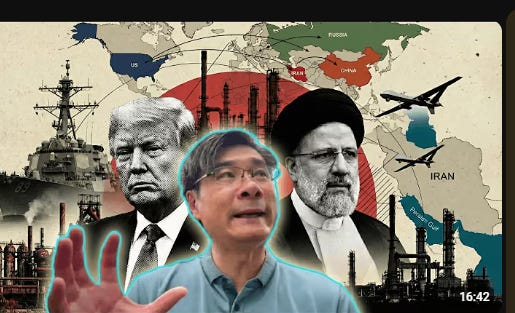
Today, I am officially releasing our tracking list of the 9 major predictions made by Professor Jiang Xueqin, the creator of the Predictive History . Now widely referred to as the “Nostradamus of China,” Jiang has moved from the fringes to the center of geopolitical discourse following his remarkable 2024 accuracy. He successfully forecasted the return of Donald Trump and the specific escalation of conflict with Iran, grounded in a unique blend of Game Theory and what Isaac Asimov called “Psychohistory.”
Applying the framework of Philip Tetlock, Jiang is a quintessential Hedgehog. Unlike the “Fox” who knows many small things and thinks in probabilities, the Hedgehog knows “one big thing.” Jiang’s “big thing” is the structural cycle of imperial collapse, specifically drawing parallels between the modern U.S. and the Athenian Empire during the Peloponnesian War. While Foxes are often better at short-term forecasting, Hedgehogs like Jiang provide the grand, sweeping theories that—when correct—redefine our understanding of the era. We will be monitoring these signposts throughout 2026 to see if his grand theory of the “Sicilian Expedition” holds true.
2. The 2026 Strategic Pivot: Empire, Rivalry, and the “Grand Bargain”
Jiang identifies 2026 as the year of structural “breaking points.” These four forecasts focus on the institutional and economic foundations of the current order:
The April 2026 “Grand Bargain” Attempt: Jiang predicts a pivotal state visit by Trump to China in April 2026. This will be a high-stakes attempt to force China back into the U.S. dollar system through a “New Plaza Accord” style negotiation. Its success or failure will dictate the decade.
The Bursting of the AI/Debt Bubble: He argues the U.S. economy is currently floating on an “AI mirage.” He predicts a reckoning in 2026 as global capital—particularly from the Gulf States—retreats from Western tech markets to cover regional war costs, leading to a massive financial correction.
The Collapse of the NATO Security Architecture: Jiang views the current European trajectory as unsustainable. He predicts a “loss of control” where the U.S. pivots entirely to the Middle East and Pacific, leaving a fragmented Europe to undergo a chaotic, internal remilitarization and political upheaval.
The End of the “Mafia State” Model: He characterizes the current U.S. administration as a “Mafia State” where personal loyalty replaces institutional strategy. He predicts this erosion of civil service and military bureaucracy will lead to a definitive “internal collapse” of administrative capability by late 2026.
3. The “Sicilian Expedition”: War, Resources, and Bifurcation
The following five predictions focus on the physical and tactical realities of the coming conflict, which Jiang compares to the disastrous Athenian invasion of Sicily:
The Mandatory U.S. Military Draft: Jiang predicts that the volunteer army model will fail during a protracted conflict with Iran. By 2026/2027, he expects the reinstatement of a national draft for 18-year-olds to sustain a war of attrition.
The Hormuz Energy Stranglehold: He forecasts that Iran will successfully close or control the Strait of Hormuz. This won’t just hurt the West; it will “strangle” global energy flows, forcing China and the U.S. into a desperate scramble for remaining physical assets.
Israel as the Sole (and Isolated) Regional Power: He predicts a “Pyrrhic victory” scenario where, after the U.S. and Iran exhaust each other, Israel remains the only standing military power in the Levant, yet finds itself in a state of total diplomatic and economic isolation.
Bitcoin’s Reveal as a State Tool: Contrasting with “cypherpunk” ideals, Jiang predicts Bitcoin will be revealed as a strategic construct (likely by the Pentagon/NSA) used to track global capital flows and maintain a digital shadow-dollar during the collapse of the traditional banking system.
Total Multipolar Bifurcation: The era of global trade as we know it ends. Jiang predicts a world split into two incompatible tech and financial ecosystems: a Western “fortress” and a China-Russia-Iran “Eurasian Heartland,” with zero interoperability between them.
My Roadmap for the Year Ahead
My goal is not to blindly follow these prophecies, but to use them as a Bayesian baseline. As events unfold—from the 2025 inauguration to the critical April 2026 window, I will update our “confidence scores” on Jiang’s thesis. Is the “Hedgehog” seeing a structural truth that the “Foxes” are missing, or is he falling into the trap of historical determinism?
I invite you to follow this tracker with us. The stakes for 2026 are not merely political; they are foundational to the global economy and the very concept of the nation-state.
The convergence of historical patterns and modern game theory suggests we are entering a “non-linear” period of history where the old rules no longer apply. Professor Jiang Xueqin has provided a provocative, high-stakes map for this territory. Whether these nine predictions manifest as literal events or serve as warnings of structural stress, they represent the one most significant “macro-thesis” currently available.
I will be right here to analyze every shift, update our models, and find the signal amidst the noise of a world in transition. Stay tuned for our monthly “Jiang Tracker” updates.If you think this exciting , incredible or even boring. Let your comment. I will submit Jiang’s questions-like in incredible plataforms such as Good Judgment .